
An Architectural Guide for Senior .NET Architects
High-Performance AI-Driven ASP.NET Core Development with ML.NET
Executive Summary
High-performance AI-driven ASP.NET Core development with ML.NET enables senior .NET architects to build low-latency, scalable, and production-ready intelligent APIs using native .NET technologies. By embedding ML.NET directly into ASP.NET Core applications, teams can deliver faster, smarter APIs without external machine-learning runtimes.
ML.NET leverages IDataView streaming pipelines, multi-threaded execution, and tight ASP.NET Core dependency injection integration, making it ideal for real-time AI inference in finance, e-commerce, cybersecurity, logistics, and IoT platforms. Unlike Python-based ML stacks, ML.NET runs inside the .NET runtime, preserving type safety, observability, memory efficiency, and operational simplicity—key requirements for enterprise systems.
Deep Dive: Internal Mechanics of ML.NET in ASP.NET Core
IDataView: The Core Performance Primitive
At the heart of high-performance ML.NET pipelines in ASP.NET Core is IDataView—a lazy, schema-based streaming abstraction optimized for large-scale data processing.
Why IDataView is critical for AI-driven ASP.NET Core APIs:
-
O(1) memory growth regardless of dataset size
-
Streaming execution instead of full dataset materialization
-
Parallelized transformations aligned with ASP.NET Core’s async request pipeline
-
Safe coexistence of training and inference workloads in production
This design allows ML.NET model inference to run alongside live ASP.NET Core traffic without blocking threads or increasing GC pressure—essential for high-throughput APIs.
ML.NET Pipeline Architecture in ASP.NET Core
ML.NET provides a fluent pipeline architecture optimized for AI-driven ASP.NET Core applications, consisting of:
-
Data preprocessing
-
Feature engineering
-
Model training
-
Model evaluation
-
Optimized inference
Built-in AutoML Capabilities
ML.NET AutoML accelerates AI model delivery in ASP.NET Core by providing:
-
Automated algorithm selection
-
Hyperparameter tuning
-
Cross-validation and scoring
This enables rapid AI prototyping while maintaining full control over enterprise architecture standards.
Key Architectural Patterns for ML.NET in ASP.NET Core
1. Model Serving Pattern (DI-First Architecture)
For production-grade ASP.NET Core ML.NET APIs, use Microsoft.Extensions.ML to inject trained models via dependency injection.
Benefits:
-
✔ Eliminates per-request model loading
-
✔ Ensures transformer reuse across requests
-
✔ Aligns with ASP.NET Core service lifetimes
-
✔ Improves cold-start and steady-state performance
This pattern is foundational for high-performance AI-driven ASP.NET Core services.
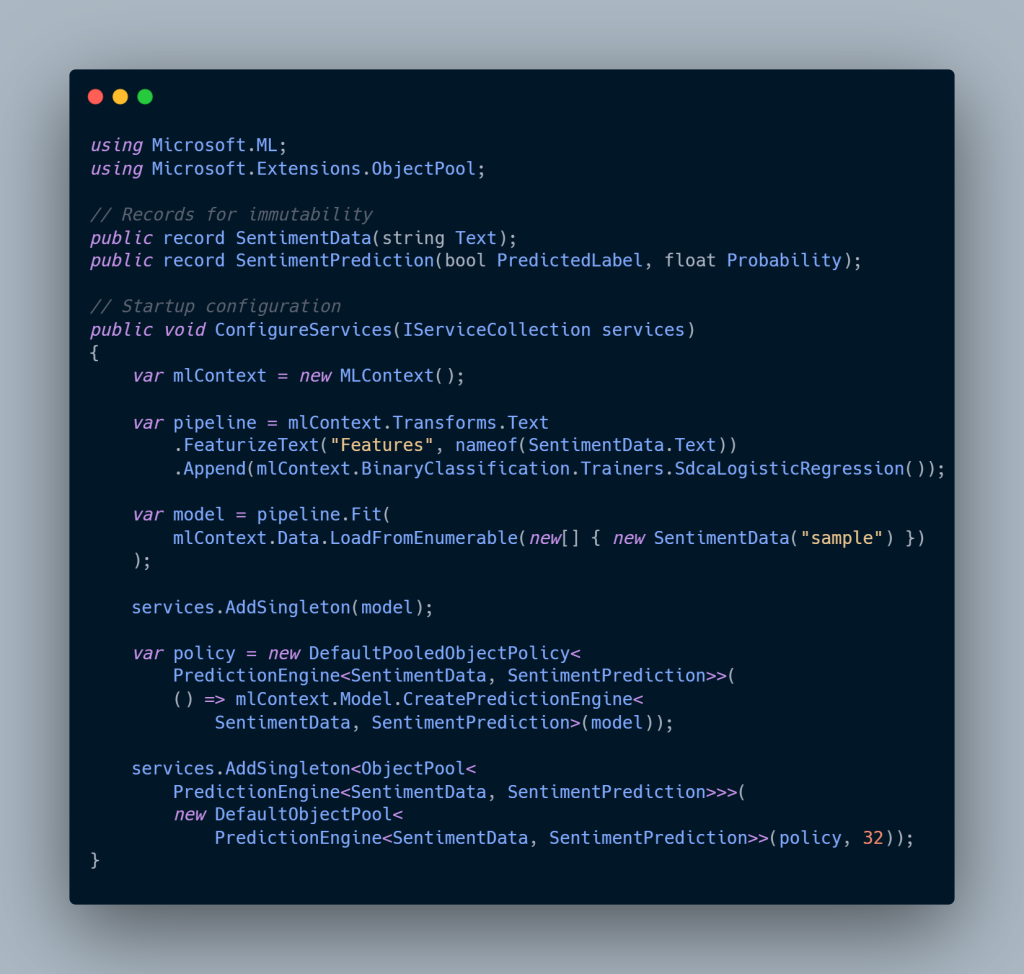
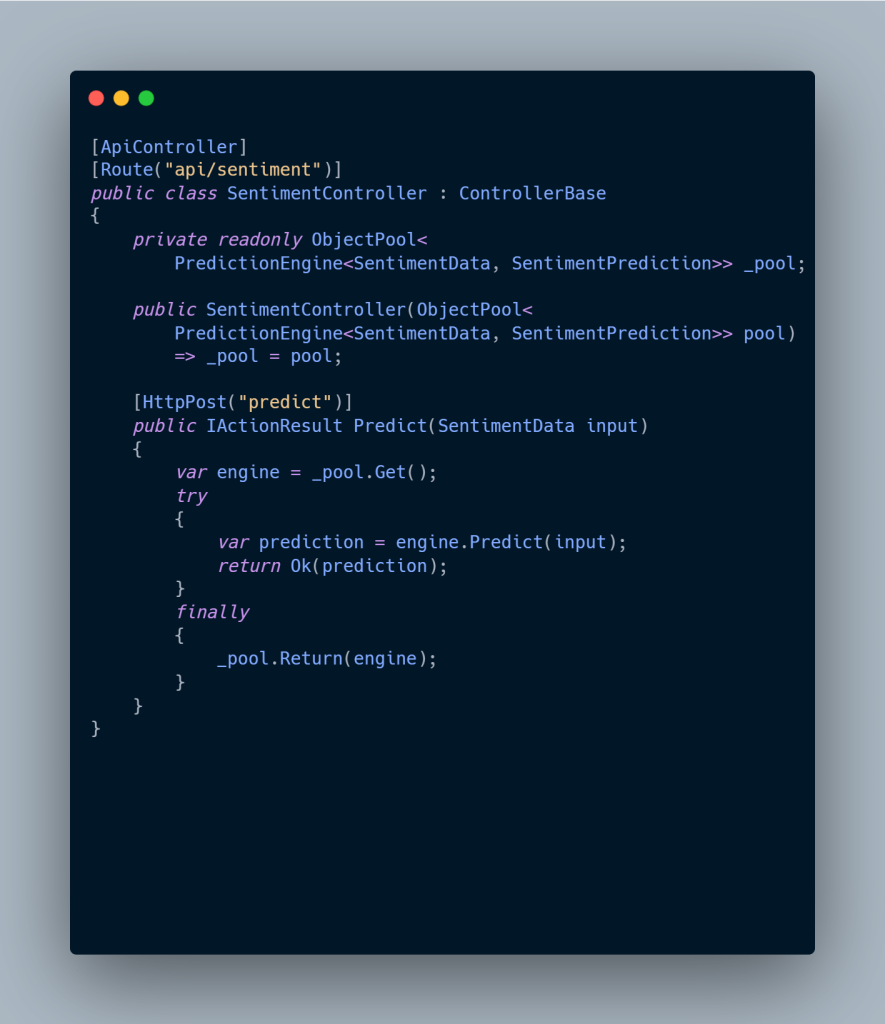
2. Object Pooling Pattern (Critical for Scale)
PredictionEngine<TSrc, TDst> is not thread-safe.
Incorrect approach (anti-pattern):
-
Creating a new PredictionEngine per request
Correct approach (high-performance pattern):
-
Pre-allocate PredictionEngines using
ObjectPool<T> -
Reuse pooled engines across concurrent ASP.NET Core requests
Observed results in real systems:
-
❌ 100–150 ms latency (naive implementation)
-
✅ Sub-10 ms inference latency under heavy load
This pattern is mandatory for scalable ML.NET inference in ASP.NET Core APIs.
Trainer Selection Strategy for AI-Driven ASP.NET Core APIs
| Trainer | Best Use Case |
|---|---|
| SDCA | Linear scalability, low memory footprint |
| FastTree / LightGBM | High-accuracy models for memory-resident datasets |
| ONNX Runtime | GPU-accelerated or deep-learning inference |
Choosing the correct trainer directly impacts API response times, memory usage, and cost efficiency in ASP.NET Core ML.NET deployments.
Technical Implementation: Optimized ASP.NET Core + ML.NET Setup
A high-performance AI-driven ASP.NET Core architecture with ML.NET should include:
-
Singleton model loading at startup
-
Object-pooled prediction engines
-
Async-friendly inference paths
-
Metrics via OpenTelemetry / Application Insights
-
Container-ready deployments (Docker, AKS, ECS)
This ensures faster, smarter APIs that meet enterprise SLOs.
Leave a Reply