Executive Summary
Modern .NET engineers are moving beyond CRUD APIs and MVC patterns into AI-Driven Development and LLM Integration in .NET.
Mastery of LLM Integration in .NET, Semantic Kernel, ML.NET and Azure AI has become essential for senior and architect-level roles, especially where enterprise systems require intelligence, automation, and multimodal data processing.
This guide synthesizes industry best practices, Microsoft patterns, and real-world architectures to help senior builders design scalable systems that combine generative AI + traditional ML for high-impact, production-grade applications.
Teams adopting AI-Driven Development and LLM Integration in .NET gain a decisive advantage in enterprise automation and intelligent workflow design.
Understanding LLMs in 2026
Large Language Models (LLMs) run on a transformer architecture, using:
- Self-attention for token relevance
- Embedding layers to convert tokens to vectors
- Autoregressive generation where each predicted token becomes the next input
- Massively parallel GPU compute during training
Unlike earlier RNN/LSTM networks, LLMs:
✔ Process entire sequences simultaneously
✔ Learn contextual relationships
✔ Scale across billions of parameters
✔ Generate human-friendly, structured responses
Today’s enterprise systems combine LLMs with:
- NLP (summaries, translation, classification)
- Agentic workflows and reasoning
- Multimodal vision & speech models
- Domain-aware RAG pipelines
These capabilities are the backbone of AI-Driven Development and LLM Integration in .NET, enabling systems that learn, reason, and interact using natural language.
Architectural Patterns for LLM Integration in .NET
.NET has matured into a first-class platform for enterprise AI, and AI-Driven Development and LLM Integration in .NET unlocks repeatable design patterns for intelligent systems.
1. Provider-Agnostic Abstraction
Use Semantic Kernel to integrate:
- OpenAI GPT models
- Azure OpenAI models
- Hugging Face
- Google Gemini
Swap providers without rewriting business logic — a core benefit in AI-Driven Development and LLM Integration in .NET.
2. Hybrid ML
Combine:
- ML.NET → local models (anomaly detection, recommendation, classification)
- LLMs → reasoning, natural language explanation, summarization
Hybrid intelligence is one of the defining advantages of AI-Driven Development and LLM Integration in .NET.
3. RAG (Retrieval-Augmented Generation)
Store enterprise data in:
- Azure Cognitive Search
- Pinecone
- Qdrant
LLMs fetch real data at runtime without retraining.
4. Agentic AI & Tool Use
Semantic Kernel lets LLMs:
- Call APIs
- Execute functions
- Plan multi-step tasks
- Read/write structured memory
This unlocks autonomous task flows — not just chat responses — forming a critical pillar of AI-Driven Development and LLM Integration in .NET
Implementation — Practical .NET Code
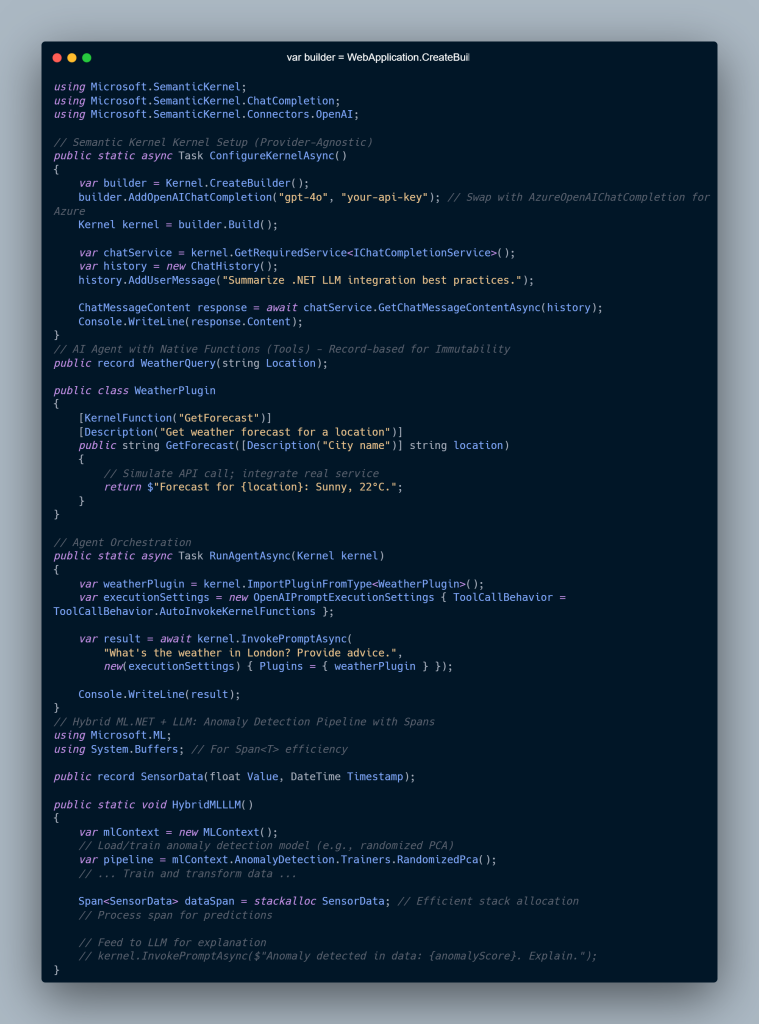
Enterprise Scenario
Imagine a manufacturing plant:
- Edge devices run ML.NET anomaly detection
- Semantic Kernel agents summarize sensor failures
- Azure OpenAI produces reports for engineers
- Kubernetes ensures scaling and uptime
This architecture:
✔ Reduces false positives
✔ Keeps sensitive data in-house
✔ Enables decision-quality outputs
Performance & Scalability
To optimize LLM Integration in .NET workloads:
🔧 Key Techniques
- Use LLamaSharp + ONNX Runtime for local inference
- Cache embeddings in Redis
- Scale inference with Azure AKS + HPA
- Reduce allocations using C# spans and records
- Use AOT compilation in .NET 8+ to decrease cold-start time
📉 Cost Controls
- Push light ML to edge devices
- Use small local models when possible
- Implement request routing logic:
- Local ML first
- Cloud LLM when necessary
Decision Matrix: .NET vs Python for AI
| Category | .NET LLM Integration | Python/LangChain |
|---|---|---|
| Performance | ⭐ High (AOT, ML.NET) | ⭐ Medium (GIL bottlenecks) |
| Cloud Fit | Azure-native integrations | Hugging Face ecosystem |
| Scalability | Built for microservices | Needs orchestration tools |
| Best Use | Enterprise production | Research & rapid prototyping |
Expert Guidance & Pitfalls
Avoid:
❌ Relying wholly on cloud LLMs
❌ Shipping proprietary data to LLMs without controls
❌ Treating an LLM like an oracle
Apply:
✔ RAG for accuracy
✔ LoRA tuning for domain precision
✔ AI agents for orchestration
✔ ML.NET pre-processing before LLM reasoning
✔ Application Insights + Prometheus for telemetry
Conclusion
LLM Integration in .NET is no longer experimental—it’s foundational.
With .NET 8+, Semantic Kernel 2.0, and ML.NET 4.0, organizations can:
- Build autonomous AI systems
- Run models locally or on cloud
- Produce enterprise-ready intelligence
- Unlock operational efficiency at scale
The future of .NET is AI-native development—merging predictive analytics, reasoning agents, and real-time data with robust enterprise software pipelines.
FAQs
❓ How do I build RAG with .NET?
Use Semantic Kernel + Pinecone/Azure Search + embeddings.
Result: 40–60% reduction in hallucination.
❓ ML.NET or Semantic Kernel?
- ML.NET = classification, forecasting, anomaly detection
- Semantic Kernel = orchestration, planning, tool-calling
Hybrid ≈ best of both.
❓ Best practice for autonomous agents?
Use:
- ReAct prompting
- Native functions
- Volatile + Long-term memory
❓ How do I scale inference?
- Quantize models
- Apply AOT
- Use AKS with autoscaling
❓ Local vs cloud inference?
Use LLamaSharp for edge, Azure OpenAI for global scale.
🌐 Internal Links
✔ “AI Development in .NET”
https://saas101.tech/ai-driven-dotnet
✔ “.NET Microservices and DevOps”
https://saas101.tech/dotnet-microservices/
✔ “Semantic Kernel in Enterprise Apps”
https://saas101.tech/semantic-kernel-guide/
✔ “Azure AI Engineering Insights”
https://saas101.tech/azure-ai/
✔ “Hybrid ML Patterns for .NET”
https://saas101.tech/ml-net-hybrid/
🌍 External Links
Microsoft + Azure Docs (Most authoritative)
🔗 Microsoft Semantic Kernel Repo
https://github.com/microsoft/semantic-kernel
🔗 Semantic Kernel Documentation
https://learn.microsoft.com/semantic-kernel/
🔗 ML.NET Docs
https://learn.microsoft.com/dotnet/machine-learning/
🔗 Azure OpenAI Service
https://learn.microsoft.com/azure/ai-services/openai/
Vector Databases (RAG-friendly)
🔗 Pinecone RAG Concepts
https://www.pinecone.io/learn/retrieval-augmented-generation/
🔗 Azure Cognitive Search RAG Guide
https://learn.microsoft.com/azure/search/search-generative-ai
Models + Optimization
🔗 ONNX Runtime Performance
https://onnxruntime.ai/
🔗 Hugging Face LoRA / Fine-tuning Guide
https://huggingface.co/docs/peft/index
(Optional)
🔗 LLamaSharp (.NET local inference)
https://github.com/SciSharp/LLamaSharp