A Modern, API-First Blueprint for Scalable Enterprise Systems
Executive Summary
Modern software systems are no longer built for a single UI or device. Web apps, mobile apps, IoT devices, partner integrations, and third-party consumers all demand access to the same business capabilities—without being tightly coupled to presentation logic.
This reality has accelerated the adoption of Headless Architecture, an API-first design approach where backend systems are completely decoupled from frontend delivery channels.
In parallel, gRPC has emerged as a high-performance communication protocol for internal microservice interactions, especially within .NET-based enterprise platforms.
This article provides a comprehensive, architect-level guide to:
Headless architecture principles in modern .NET systems
API-first backend design and frontend decoupling strategies
Where gRPC fits—and where it doesn’t
When to choose gRPC vs REST in headless architectures
Real-world enterprise implementation patterns
Best practices for scalability, security, and maintainability
This guide is written for senior .NET developers, architects, and technical leads designing systems intended to scale beyond a single UI or platform.
What Is Headless Architecture?
Headless architecture is a system design approach where:
The backend contains only business logic and APIs
The frontend is completely decoupled
No UI assumptions exist inside backend services
In a headless system, the backend becomes a pure capability provider.
Key Characteristics
API-first design
Multiple frontend consumers
Independent deployment cycles
Technology-agnostic frontends
Long-term scalability
The backend exposes functionality through APIs, while any number of frontends—React, Angular, mobile apps, kiosks, or third-party systems—consume those APIs independently.
Why Headless Architecture Matters in Enterprise .NET Systems
Traditional monolithic .NET applications often mix:
Business logic
UI rendering
State management
API concerns
This coupling creates friction when:
Adding new client platforms
Scaling teams independently
Integrating with partners
Modernizing legacy frontends
Headless architecture solves these problems by enforcing clear architectural boundaries.
Enterprise Benefits
Faster frontend innovation
Reduced regression risk
Easier cloud scaling
Clear ownership between teams
Better long-term maintainability
API-First Design in .NET: The Foundation of Headless Systems
A headless backend must be API-first, meaning APIs are treated as first-class products—not implementation details.
In .NET, this typically means:
ASP.NET Core Web APIs
Strong contract definitions
Versioned endpoints
Explicit backward compatibility
API-First Principles
Design contracts before implementation
Treat APIs as public interfaces—even internally
Never expose UI assumptions
Optimize for long-term evolution
This is where protocol choice becomes critical.
REST vs gRPC in Headless Architectures
Headless architecture does not mandate a single protocol. Instead, different protocols serve different roles.
REST: External Consumption Layer
REST remains ideal for:
Browsers
Mobile apps
Third-party consumers
SEO-friendly platforms
Why REST works well externally:
Human-readable JSON
Wide tooling support
Easy debugging
Cache-friendly
Works naturally over HTTP
gRPC: Internal Service-to-Service Communication
gRPC is not a replacement for REST in headless architectures—it is a complement.
gRPC excels when:
Microservices communicate internally
Low latency is critical
Strong typing is required
High throughput is expected
Why Enterprises Use gRPC Internally
Binary serialization (Protocol Buffers)
Strict contracts
Excellent performance
Language-agnostic communication
Built-in streaming support
How gRPC Fits into a Headless .NET Architecture
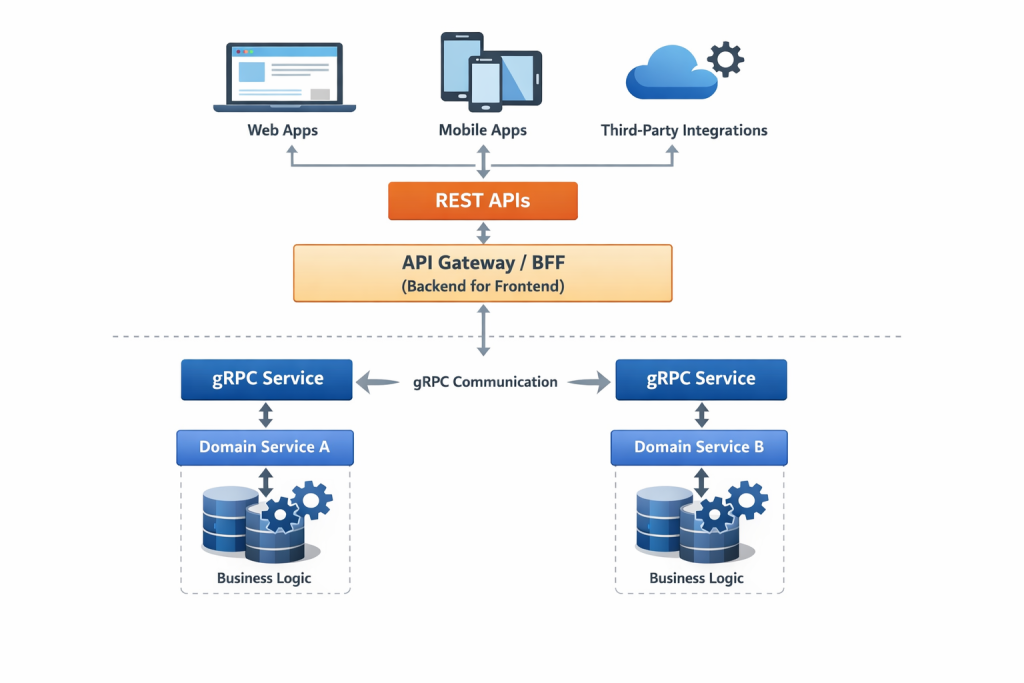
A modern enterprise architecture often looks like this:
Headless Architecture in .NET Microservices with gRPC 3
Architectural Roles
REST APIs → Expose headless capabilities to external consumers
API Gateway / BFF (Backend for Frontend) → Aggregates, secures, and adapts APIs per client type
gRPC Services → High-performance internal communication between microservices
This separation preserves headless principles without forcing gRPC onto frontends, where it is often impractical.
Decoupling Presentation from Business Logic in .NET
True headless architecture requires discipline, not just APIs.
Headless Architecture
Best Practices
No UI logic in backend projects
No frontend-specific DTOs in domain layers
Domain logic isolated from transport concerns
Contracts owned and versioned explicitly
In .NET, this often aligns with:
Clean Architecture
Hexagonal Architecture
Vertical Slice Architecture
Enterprise Implementation Patterns
Pattern 1: Backend for Frontend (BFF)
Each frontend gets its own tailored backend façade.
Benefits:
Avoids frontend overfetching
Simplifies UI logic
Improves security isolation
Pattern 2: API Gateway + gRPC Mesh
Gateway handles REST, auth, rate limits
Microservices communicate via gRPC
Benefits:
High internal performance
Clean separation of concerns
Easier scaling under load
Pattern 3: Hybrid Headless Platform
Public REST APIs for partners
Internal gRPC for core services
Event-driven messaging for async workflows
This pattern is common in large-scale .NET systems.
Security Considerations in Headless + gRPC Systems
Enterprise headless systems must address:
Authentication (OAuth2, OpenID Connect)
Authorization (policy-based access)
Transport security (TLS everywhere)
Service identity (mTLS internally)
gRPC works particularly well with mutual TLS for internal service trust.
Common Mistakes Architects Should Avoid
❌ Exposing gRPC directly to browsers
❌ Mixing UI logic into APIs
❌ Treating APIs as internal shortcuts
❌ Ignoring versioning strategy
❌ Over-engineering protocol usage
Headless architecture is about clarity and separation, not complexity.
When NOT to Use gRPC
Despite its strengths, gRPC is not always appropriate:
Public APIs consumed by unknown clients
SEO-dependent web platforms
Simple CRUD systems
Teams without protocol buffer expertise
Architecture is about fit, not fashion.
Final Thoughts: Designing for the Next 5 Years
Headless architecture paired with gRPC is not a trend—it is a long-term architectural strategy.
For .NET architects, the winning approach is:
REST for external headless APIs
gRPC for internal microservice communication
Strong architectural boundaries
API-first thinking from day one
This combination delivers scalability, performance, and adaptability—the three qualities enterprise systems must sustain over time.
About the Author
This article is written from an enterprise .NET architecture perspective, informed by real-world experience designing scalable, cloud-native systems using ASP.NET Core, microservices, and distributed architectures.