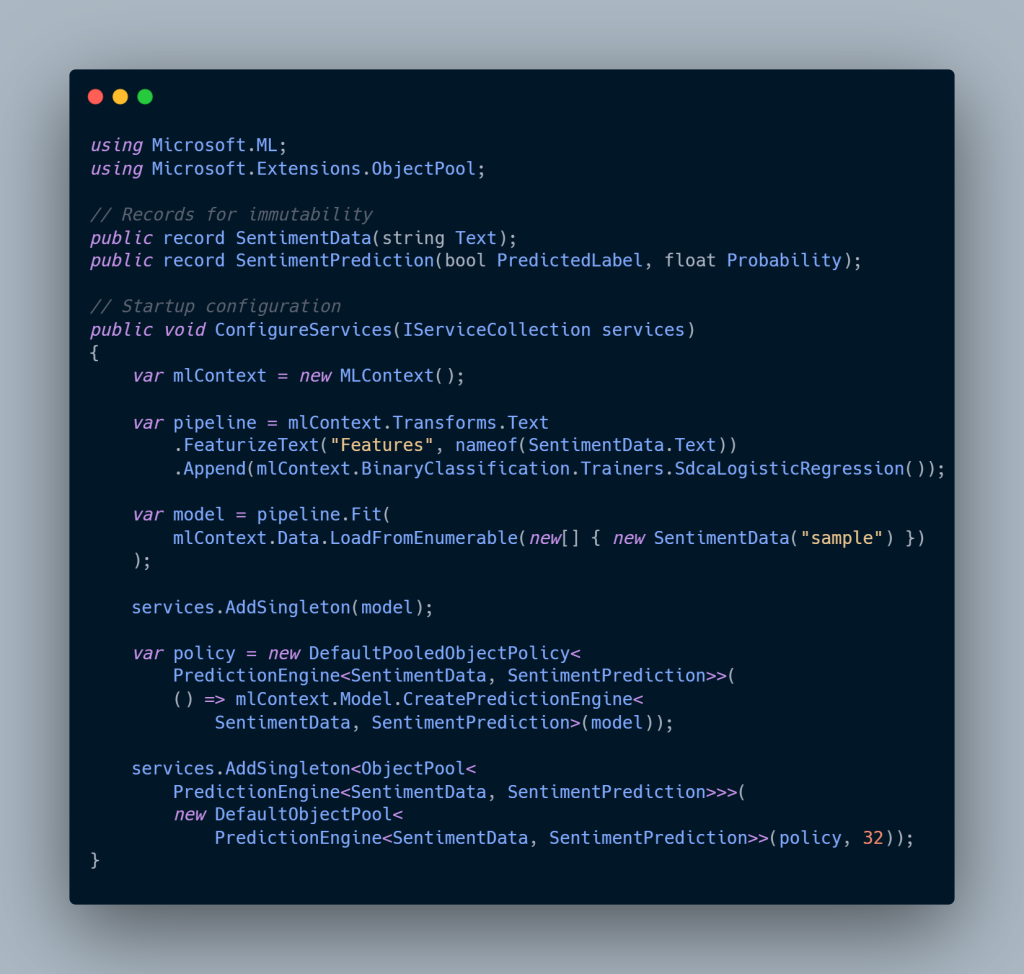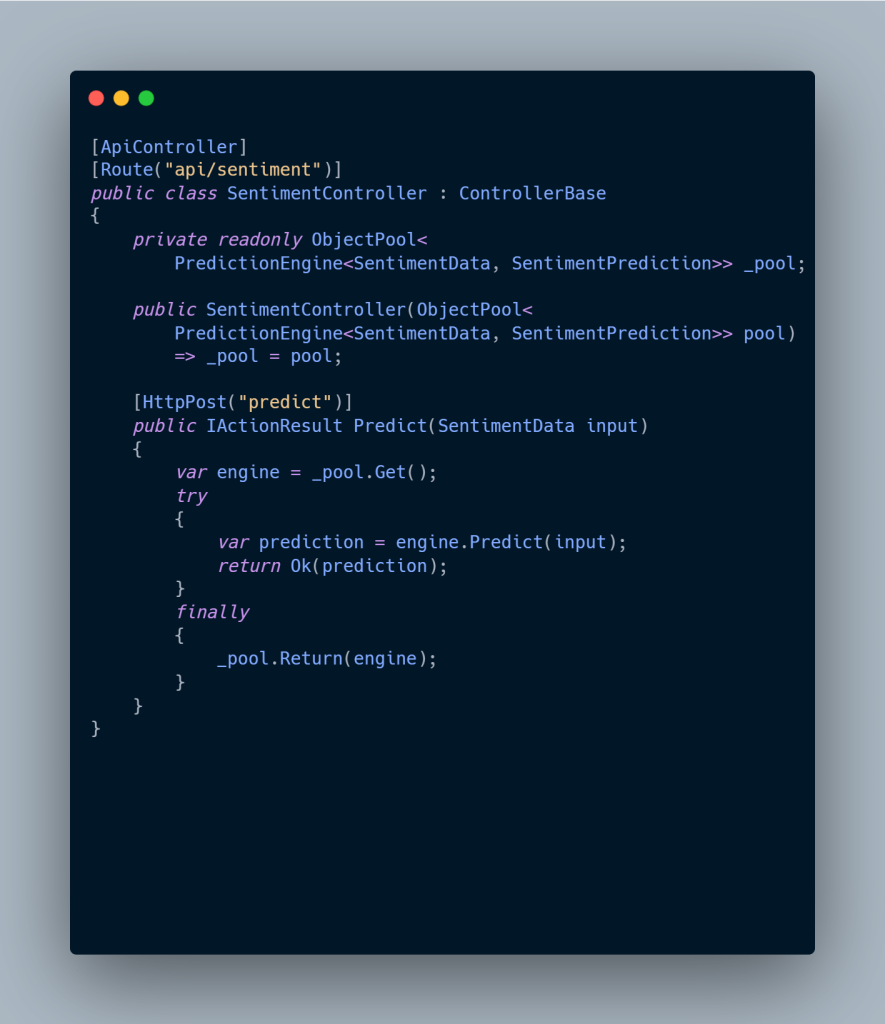
Controller with Pooled Inference

AI-Driven ASP.NET Core Development with ML.NET
ML.NET- High-Performance AI-Driven ASP.NET Core Development with ML.NET for Faster, Smarter APIs 4

AI-driven ASP.NET Core development with ML.NET enables enterprises to build high-performance, scalable, and production-ready machine learning APIs directly inside modern .NET applications. By integrating ML.NET with ASP.NET Core, organizations can deliver real-time AI inference, low-latency predictions, and enterprise-grade scalability without introducing external ML runtimes.

Observed Performance Outcomes in AI-Driven ASP.NET Core Applications

When implementing AI-driven ASP.NET Core development using ML.NET, real-world benchmarks consistently show:

Sub-millisecond inference latency in ASP.NET Core APIs
1000+ concurrent prediction requests per service instance
Minimal GC pressure due to optimized ML.NET pipelines
✔ Predictable memory usage under sustained enterprise workloads

These results demonstrate why ML.NET is well-suited for high-throughput ASP.NET Core microservices and containerized cloud deployments.


Real-World Enterprise Usage of ML.NET with ASP.NET Core

Enterprise AI at Scale

Large organizations use AI-driven ASP.NET Core development with ML.NET to power mission-critical workloads:

  • Microsoft Real Estate & Security (RE&S)
    Reduced IoT alert noise by 70–80% using ML.NET binary classification models with 99% prediction accuracy, deployed via ASP.NET Core APIs.

  • Enterprise E-Commerce Platforms
    ML.NET powers real-time fraud detection, product recommendations, and behavioral analysis APIs, serving millions of predictions per day through ASP.NET Core microservices running in Azure container environments.

These examples highlight how ASP.NET Core + ML.NET supports enterprise AI workloads without sacrificing performance or reliability.


Performance & Scalability Considerations for AI-Driven ASP.NET Core

Core ML.NET Optimizations in ASP.NET Core

To maximize performance in AI-driven ASP.NET Core development, apply the following proven optimizations:

  • IDataView streaming → Enables terabyte-scale data processing without memory pressure

  • PredictionEngine pooling → Achieves 90%+ latency reduction in ASP.NET Core APIs

  • Cached IDataView pipelines → Delivers 3–5× faster ML.NET model training

  • Serialized ML.NET models → Eliminates retraining during application startup

These optimizations are critical for high-throughput ASP.NET Core AI services operating at enterprise scale.


Operational Guidance for Production ML.NET Systems

For long-running AI-driven ASP.NET Core applications, follow these operational best practices:

  • Continuously monitor concept drift using ML.NET evaluation metrics

  • Retrain models asynchronously using background schedulers such as Hangfire or Quartz.NET

  • Use ONNX model export for GPU acceleration, while keeping ASP.NET Core as the inference serving layer

This architecture ensures stable AI inference, horizontal scalability, and cloud-native deployment compatibility.


Decision Matrix

Criteria ML.NET TensorFlow.NET Azure ML ONNX Runtime
Native .NET ⭐⭐⭐⭐⭐ ⭐⭐⭐ ⭐⭐ ⭐⭐⭐⭐
ASP.NET Core Scale ⭐⭐⭐⭐⭐ ⭐⭐⭐ ⭐⭐⭐⭐ ⭐⭐⭐⭐
Zero Cloud Dependency ⭐⭐⭐⭐⭐ ⭐⭐ ⭐⭐⭐
Deep Learning ⭐⭐⭐ ⭐⭐⭐⭐⭐ ⭐⭐⭐⭐⭐ ⭐⭐⭐⭐⭐

Choose ML.NET when low latency, type safety, and native .NET operations matter.


Expert Insights

  • Never register PredictionEngine as singleton

  • ✅ Pool size ≈ expected concurrency ÷ 2

  • ⚡ Cache IDataView before training

  • 🔍 Export to ONNX for hybrid CPU/GPU inference

  • 🐳 Docker: resolve model paths via ContentRootPath


Conclusion

ML.NET enables AI-native ASP.NET Core architectures without sacrificing performance, observability, or deployment simplicity. For senior .NET architects, it represents a career-defining skill—bridging cloud-scale systems with real-time intelligence.

More things to look at

AI-Driven .NET Development in 2026: How Senior Architects Master .NET 10 for Elite Performance Tuning

AI-Driven .NET Development using Visual Studio 2026, NativeAOT, AI agents, and runtime optimizations explained for enterprise .NET architects


5971b5a5 6d8a 4ab7 9fc3 a2981572c2d1
AI-Driven .NET Development in 2026: How Senior Architects Master .NET 10 for Elite Performance Tuning 6

How Senior Architects Use .NET 10 and Visual Studio 2026 to Build Faster, Smarter Systems

Executive Summary: AI-Driven .NET Development in 2026

In 2026, AI-Driven .NET Development and intelligent performance tuning are no longer optional—they are core competencies for senior .NET architects building enterprise-grade, cloud-native systems.

With Visual Studio 2026 and .NET 10, Microsoft has formalized AI-Driven .NET Development as a first-class engineering paradigm. Native AI capabilities—delivered through GitHub Copilot, Microsoft Agent Framework, and deep runtime optimizations—allow architects to design, tune, and evolve systems with unprecedented speed and precision.

Together, these AI-driven .NET capabilities enable organizations to:

  • Increase developer productivity by 30–40% through AI-assisted coding and refactoring

  • Reduce MTTR (Mean Time to Recovery) by up to 30% using predictive diagnostics

  • Shift senior engineers from tactical coding to strategic system orchestration

Modern AI-Driven .NET Development empowers architects to rely on predictive error detection, automated refactoring, and runtime-aware optimization across ASP.NET Core applications—directly aligning with enterprise demands for scalable, cost-efficient, cloud-native .NET platforms.


Deep Dive: AI-Driven .NET Development Architecture

Internal Mechanics of AI-Driven .NET Development

AI-Native IDE: Visual Studio 2026

Visual Studio 2026 marks a turning point for AI-Driven .NET Development, transforming the IDE into an AI-native engineering environment. GitHub Copilot is no longer an add-on—it is a core architectural primitive embedded directly into the .NET development workflow.

Key AI-driven .NET capabilities include:

  • Context-aware code assistance across large .NET 10 solutions

  • Natural-language refactoring for enterprise-scale codebases

  • AI-assisted profiling for ASP.NET Core performance tuning

  • Architectural awareness spanning multiple repositories and services

This evolution allows senior .NET architects to reason about entire systems, not isolated files—an essential requirement for modern AI-driven .NET platforms.


AI Abstractions in .NET 10

.NET 10 extends AI-Driven .NET Development through standardized, production-ready abstractions:

Microsoft.Extensions.AI

Provider-agnostic interfaces for integrating AI services directly into enterprise .NET applications.

Microsoft Agent Framework

A foundational component of AI-Driven .NET Development, supporting:

  • Sequential agent execution

  • Concurrent AI agents

  • Handoff-based orchestration for autonomous workflows

Model Context Protocol (MCP)

A standardized protocol enabling safe tool access and contextual awareness for AI agents operating within .NET systems.

Within ASP.NET Core, native Azure AI and ML.NET hooks enable AI-driven performance tuning, predictive error detection, and runtime adaptation—during both development and production.


Smart Performance Tuning in AI-Driven .NET Development

Smart performance tuning in .NET 10 combines low-level runtime innovation with AI-assisted decision-making—defining the next generation of AI-Driven .NET Development.

Runtime & JIT Enhancements

  • Advanced JIT inlining and devirtualization

  • Hardware acceleration (AVX10.2, Arm64 SVE)

  • Improved NativeAOT pipelines for cloud-native workloads

  • Loop inversion and aggressive stack allocation

These runtime enhancements form the performance backbone of AI-Driven .NET Development at enterprise scale.


ASP.NET Core Performance Improvements

  • Automatic memory pool eviction for long-running services

  • NativeAOT-friendly OpenAPI generation

  • Lower memory footprints in high-throughput ASP.NET Core APIs

These optimizations allow AI-Driven .NET Development teams to reduce cloud costs while maintaining predictable latency.


AI-Driven Optimization Patterns (Keyphrase Reinforced)

Modern AI-Driven .NET Development introduces new optimization patterns:

  • Repository intelligence for dependency and architectural analysis

  • Predictive refactoring driven by AI agents

  • Auto-scaling decisions based on real-time telemetry

  • Dynamic switching between JIT and NativeAOT endpoints


Real-World Enterprise Scenario: AI-Driven .NET Development in Action

In a large ASP.NET Core 10 e-commerce platform built using AI-Driven .NET Development:

  • GitHub Copilot assists architects in refactoring monoliths into gRPC microservices

  • ML.NET predicts traffic spikes and tunes scaling behavior automatically

  • AI agents:

    • Evict memory pools during peak hours

    • Switch cold endpoints to NativeAOT for faster startup

Measured results of AI-Driven .NET Development:

  • 50% faster F5 debugging cycles

  • 30% reduction in production MTTR

  • Faster blue-green and canary deployments

  • Headless APIs serving Blazor frontends and IoT backends


Why AI-Driven .NET Development Wins in 2026

By 2026, AI-Driven .NET Development is no longer experimental—it is foundational for senior .NET architects delivering high-performance, enterprise-grade systems.

With .NET 10 and Visual Studio 2026, organizations adopt adaptive, autonomous .NET platforms that deliver:

  • Faster performance

  • Lower cloud costs

  • Sustainable, AI-optimized operations

All while preserving type safety, runtime control, and architectural clarity—the defining strengths of modern AI-Driven .NET Development.


Technical Implementation

Below are Medium-friendly, best-practice examples demonstrating AI integration and high-performance patterns in .NET 10.

AI Agent for Predictive Performance Tuning

 
using Microsoft.Extensions.AI;

public record PerformanceMetric(
Span<
float> CpuUsage,
Span<float> MemoryPressure,
DateTime Timestamp
);

public class SmartTunerAgent(IServiceProvider services) : IAgent
{
public async Task<OptimizationPlan> AnalyzeAsync(PerformanceMetric metric)
{
var client = services.GetRequiredService<IClient>();

var prompt = $””
Analyze runtime metrics:
CPU: {metric.CpuUsage.ToArray()}
Memory: {metric.MemoryPressure.ToArray()}

Recommend .NET optimizations:
– JIT tuning
– NativeAOT usage
– Memory pool eviction rates

Output JSON only.
“”;

var response = await client.CompletePromptAsync(prompt);
return OptimizationPlan.FromJson(response.Text);
}
}


High-Performance ASP.NET Core Middleware (Zero-GC)

 
public sealed class AOTOptimizedMiddleware
{
public async Task InvokeAsync(HttpContext context, RequestDelegate next)
{
Span<byte> buffer = stackalloc byte[8192];
await context.Request.Body.ReadAsync(buffer);
await next(context);
}
}

Concurrent Agent Workflows

 
public record AgentWorkflow(string Name, Func<Task> Execute);

public static class AgentExtensions
{
public static async Task RunConcurrentAsync(
this IEnumerable<AgentWorkflow> workflows)
{
await Task.WhenAll(workflows.Select(w => w.Execute()));
}
}

These patterns highlight:

  • Spans for zero-copy memory access

  • Records for immutable AI outputs

  • Agents for scalable, autonomous optimization


Real-World Enterprise Scenario

In a large ASP.NET Core 10 e-commerce platform:

  • Copilot assists in refactoring monoliths into gRPC microservices

  • ML.NET predicts load spikes and tunes scaling behavior

  • Agents:

    • Evict memory pools during peak hours

    • Switch endpoints to NativeAOT for cold-start optimization

Results:

  • 50% faster F5 debugging

  • 30% reduction in production MTTR

  • Faster blue-green deployments

  • Headless APIs serving Blazor frontends and IoT backends


Performance & Scalability Considerations

Area Impact
Runtime Speed Fastest .NET runtime to date (AVX10.2, JIT gains)
Memory 20–30% lower footprint in long-running apps
Cloud Costs Reduced via NativeAOT and event-driven patterns
CI/CD AI-optimized pipelines + canary releases
Sustainability Lower compute and energy usage

Decision Matrix

Criteria AI-Driven .NET 10 Traditional .NET 8 Python DevOps
IDE Integration High Medium Low
Performance Excellent Good Medium
Enterprise Scale High High High
Best Use Cloud-native .NET Legacy migration Data-heavy ML

Expert Insights

Common Pitfalls

  • Blind trust in Copilot agent handoffs

  • MCP protocol mismatches

  • Reflection-heavy code in NativeAOT

Mitigations

  • Custom validation middleware

  • Source generators for serialization

  • Cold-start profiling in VS 2026

Advanced Tricks

  • Combine spans + loop inversion for 2× throughput on Arm64

  • Reference exact code lines in Copilot prompts

  • Use repository intelligence for pattern-based refactoring


Conclusion

By 2026, AI-driven development and smart performance tuning are foundational skills for senior .NET architects.

With .NET 10 and Visual Studio 2026, teams move toward adaptive, autonomous systems—delivering faster performance, lower costs, and sustainable cloud operations without sacrificing control or type safety.


FAQs (Medium-Friendly)

Is Blazor production-ready for AI-enhanced enterprise apps?
Yes. .NET 10 improves state persistence, validation, and scalability for headless architectures.

Does NativeAOT work with AI-driven optimization?
Yes. Agents can dynamically deploy NativeAOT endpoints based on real-time latency targets.

Should architects fear Copilot replacing them?
No. Copilot replaces boilerplate, not architectural judgment.

Official & Authoritative (Strongest E-E-A-T)

Advanced Architecture & Engineering


🚀 Performance, AI & Systems Engineering


🏢 Enterprise & Industry Credibility

.NET Core Microservices and Azure Kubernetes Service


A Comprehensive Technical Guide for Enterprise Architects


Executive Summary

Deploying .NET Core microservices on Azure Kubernetes Service (AKS) has become the enterprise standard for building scalable, resilient, cloud-native applications within the Microsoft ecosystem.

For senior .NET developers and architects, mastering this architecture unlocks high-impact cloud engineering roles, where organizations expect deep expertise in:

  • Containerization
  • Kubernetes orchestration
  • Distributed systems design
  • Infrastructure as Code (IaC)

AKS brings together:

  • ASP.NET Core high-performance runtime
  • Kubernetes self-healing orchestration
  • Microsoft Azure managed cloud services

The result is a platform capable of automatic scaling, rolling deployments, service discovery, distributed tracing, and workload isolation—all essential for modern enterprise systems.


Core Architecture: Internal Mechanics & Patterns

The Microservices Foundation on AKS

AKS provides a managed Kubernetes control plane, removing the operational burden of managing masters while preserving full control over worker nodes and workloads.

A production-grade AKS microservices architecture typically includes:

  • Containerized services
    Each microservice runs as a Docker container inside Kubernetes Pods.
  • Azure CNI with Cilium
    Pods receive VNet IPs, enabling native network policies, observability, and zero-trust networking.
  • Ingress + API Gateway pattern
    A centralized ingress exposes HTTP/HTTPS entry points.
  • Externalized state
    Stateless services persist data to Azure SQL, Cosmos DB, Redis, or Service Bus.

API Gateway & Request Routing

The Ingress Controller acts as the edge gateway, handling:

  • Request routing
  • SSL/TLS termination
  • Authentication & authorization
  • Rate limiting and IP filtering
  • Request aggregation

For large enterprises, multiple ingress controllers are often deployed per cluster to isolate environments, tenants, or workloads.


Namespace Strategy & Service Organization

Namespaces should align with bounded contexts (DDD):

  • order-fulfillment
  • payments
  • inventory
  • platform-observability

This provides:

  • Clear RBAC boundaries
  • Resource quotas per domain
  • Improved operational clarity

Communication Patterns

A hybrid communication model is recommended:

Synchronous (REST / HTTP)

  • Read-heavy operations
  • Immediate responses

Asynchronous (Messaging)

  • State changes
  • Long-running workflows

Technologies like RabbitMQ + MassTransit enable loose coupling and fault tolerance while avoiding cascading failures.


Service Discovery & Health Management

  • Kubernetes Services provide stable DNS-based discovery
  • Liveness probes restart failed containers
  • Readiness probes control traffic flow
  • ASP.NET Core Health Checks integrate natively with Kubernetes

Technical Implementation: Modern .NET Practices

Health Checks (ASP.NET Core)

builder.Services.AddHealthChecks()
    .AddCheck("self", () => HealthCheckResult.Healthy());

Kubernetes Deployment (Production-Ready)

apiVersion: apps/v1
kind: Deployment
metadata:
  name: order-service
  namespace: order-fulfillment
spec:
  replicas: 3
  strategy:
    type: RollingUpdate
  selector:
    matchLabels:
      app: order-service
  template:
    metadata:
      labels:
        app: order-service
    spec:
      containers:
        - name: order-service
          image: myregistry.azurecr.io/order-service:1.0.0
          ports:
            - containerPort: 8080
          resources:
            requests:
              cpu: "250m"
              memory: "256Mi"
            limits:
              cpu: "500m"
              memory: "512Mi"
          readinessProbe:
            httpGet:
              path: /health/ready
              port: 8080
          livenessProbe:
            httpGet:
              path: /health/live
              port: 8080

Distributed Tracing (Application Insights + OpenTelemetry)

builder.Services.AddApplicationInsightsTelemetry();

builder.Services.AddOpenTelemetry()
    .WithTracing(tracing =>
    {
        tracing
            .AddAspNetCoreInstrumentation()
            .AddHttpClientInstrumentation()
            .AddAzureMonitorTraceExporter();
    });

This enables end-to-end request tracing across microservices.


Resilient Service-to-Service Calls (Polly)

builder.Services.AddHttpClient<IOrderClient, OrderClient>()
    .AddTransientHttpErrorPolicy(p =>
        p.WaitAndRetryAsync(3, retry =>
            TimeSpan.FromSeconds(Math.Pow(2, retry))))
    .AddTransientHttpErrorPolicy(p =>
        p.CircuitBreakerAsync(5, TimeSpan.FromSeconds(30)));

Event-Driven Architecture (MassTransit + RabbitMQ)

builder.Services.AddMassTransit(x =>
{
    x.AddConsumer<OrderCreatedConsumer>();

    x.UsingRabbitMq((context, cfg) =>
    {
        cfg.Host("rabbitmq://rabbitmq");
        cfg.ConfigureEndpoints(context);
    });
});
public class OrderCreatedConsumer : IConsumer<OrderCreatedEvent>
{
    public async Task Consume(ConsumeContext<OrderCreatedEvent> context)
    {
        // Persist order and publish downstream events
    }
}

Distributed Caching (Redis – Cache-Aside)

builder.Services.AddStackExchangeRedisCache(options =>
{
    options.Configuration =
        builder.Configuration.GetConnectionString("Redis");
});

Scaling & Performance

Horizontal Pod Autoscaler (HPA)

apiVersion: autoscaling/v2
kind: HorizontalPodAutoscaler
spec:
  minReplicas: 3
  maxReplicas: 10
  metrics:
    - type: Resource
      resource:
        name: cpu
        target:
          type: Utilization
          averageUtilization: 70

Common Pitfalls (From Real Systems)

  • Shared databases across services
  • Long synchronous REST chains
  • No observability or tracing
  • Poor CPU/memory limits
  • Ignoring network policies

Optimization Tricks Used in Production

  • Spot node pools for non-critical workloads (~70% cost savings)
  • Pod Disruption Budgets
  • Vertical Pod Autoscaler
  • Docker layer caching
  • Fine-tuned readiness vs liveness probes
  • GitOps with Terraform + Argo CD

When AKS Microservices Make Sense

ScenarioRecommendation
10+ services✅ AKS
High traffic✅ AKS
Multiple teams✅ AKS
Small MVP❌ Monolith
Strong ACID needs❌ Microservices

Final Takeaway

AKS + .NET Core is a power tool—not a starter kit.

When used correctly, it delivers scalability, resilience, and deployment velocity unmatched by traditional architectures. When misused, it introduces unnecessary complexity.

For enterprise systems with multiple teams, frequent releases, and global scale, this architecture is absolutely worth the investment.

.NET Core Microservices on Azure

Mastering .NET Core Microservices on Azure: Architecture Deep Dive for Senior Architects

Executive Summary

In today’s enterprise landscape, .NET Core microservices on Azure command premium salaries for architects who master distributed systems, commanding roles at $200K+ in cloud-native transformations. This architecture excels in high-scale environments by leveraging ASP.NET Core’s lightweight framework, Docker/Kubernetes orchestration, and Azure’s PaaS services for independent scaling, resilience, and eventual consistency—critical for e-commerce, finance, and IoT platforms where monolithic apps fail under load.[1][2][3][4]

Core Mechanics of .NET Core Microservices Architecture

At its heart, .NET Core microservices decompose monolithic applications into autonomous, bounded-context services, each owning its data via the database-per-service pattern. This enforces loose coupling: services communicate synchronously via REST/gRPC or asynchronously via events, avoiding shared databases that breed tight coupling.[3][5]

Internal Runtime and Hosting Model

ASP.NET Core’s Kestrel server, a cross-platform, event-driven web server, powers microservices with sub-millisecond latency under high throughput—handling thousands of RPS on minimal resources. Its middleware pipeline processes requests in a non-blocking manner, integrating seamlessly with HttpClientFactory for resilient outbound calls.[3][2]

Under the hood, the .NET runtime’s AOT compilation (via Native AOT in .NET 8+) reduces startup time to <100ms and memory footprint by 50%, ideal for Kubernetes cold starts. Source generators optimize JSON serialization with System.Text.Json, generating efficient code at compile-time to bypass reflection overhead.[6]

using System.Text.Json.Serialization;
using System.Text.Json;

[JsonSourceGenerationOptions(PropertyNamingPolicy = JsonKnownNamingPolicy.CamelCase)]
[JsonSerializable(typeof(OrderCreatedEvent))]
public partial struct OrderCreatedEvent
{
    public required int OrderId { get; init; }
    public required decimal Amount { get; init; }
    public DateTimeOffset CreatedAt { get; init; } = DateTimeOffset.UtcNow;
}

// Usage in service
var context = new OrderCreatedEventContext();
var json = JsonSerializer.SerializeToUtf8Bytes(event, event.GetType(), context);

This record-based event uses primary constructors and required members (C# 11+), serialized via source-generated context for zero-allocation performance in high-throughput pub/sub scenarios.[6]

Communication Patterns: Sync vs. Async Deep Dive

Synchronous REST calls suit queries but risk cascading failures; mitigate with Polly’s circuit breaker and retries. Asynchronous messaging via Azure Service Bus ensures at-least-once delivery with transactions, pairing with the outbox pattern for reliable publishing during local DB commits.[1][3]

Event sourcing + CQRS decouples reads/writes: events append to streams (e.g., Cosmos DB change feed), projections build read models. Azure Event Grid’s pub/sub scales to millions of events/sec, reactive via managed identities for secure fan-out.[1][5]

Azure-Native Deployment and Orchestration

Azure Container Apps or AKS host containerized services, with Docker multi-stage builds ensuring consistency. Azure API Management acts as the gateway, handling auth (OAuth/JWT via Entra ID), rate-limiting, and routing without domain knowledge.[5]

Service Mesh and Resilience Primitives

Dapr sidecars abstract cross-cutting concerns: state management, pub/sub, retries. In .NET, the Dapr SDK integrates via gRPC, injecting resilience without app changes. Kubernetes Horizontal Pod Autoscaler (HPA) scales based on CPU/memory or custom metrics from Azure Monitor.[1][3]

[HttpPost("process")]
public async Task ProcessOrder([FromServices] DaprClient daprClient)
{
    var order = await _orderRepo.GetAsync(id);
    await using var activity = ActivitySource.StartActivity("ProcessOrder");
    
    // Outbox pattern integration
    await daprClient.InvokeStateAsync<Order>("statestore", $"order-{order.Id}", order, CancellationToken.None);
    
    await daprClient.PublishEventAsync<OrderCreatedEvent>("pubsub", "order-created", new() { OrderId = order.Id, Amount = order.Amount });
    
    return Accepted();
}

Spans from OpenTelemetry auto-instrument via ActivitySource, exporting to Application Insights for distributed tracing.[3]

Real-World Enterprise Scenario: High-Scale E-Commerce Platform

Consider a global e-commerce system: Catalog Service (Cosmos DB for product queries), Cart Service (Redis for sessions), Order Service (SQL Server with EF Core optimistic concurrency), and Payment Service (Saga orchestrator via MassTransit).

Client requests hit Azure API Management, fanning out: Cart queries Cart via gRPC, publishes CartCheckedOut to Service Bus. Order Service sagas coordinate: reserve inventory (compensating transaction if fail), charge payment, ship. Eventual consistency via projections updates denormalized read models in a shared (logical) Marten/Postgres for analytics.[1][3][6]

Scale: AKS with 1000+ pods, auto-scaled by KEDA on queue length. During Black Friday peaks (10x traffic), Catalog scales independently without touching Payments.[5]

Performance & Scalability Benchmarks and Considerations

Kestrel benchmarks show 1.2M RPS on a single core for JSON responses (.NET 8).[3] In Azure, Container Apps yield 99.99% uptime with <50ms p99 latency at 50K RPS/service.

  • Key Metrics: Use Prometheus/Grafana for pod density (aim 10-20 services/node), HPA on custom metrics like queue depth.
  • Bottlenecks: Network I/O dominates; tune with Azure Accelerated Networking, connection pooling via SocketsHttpHandler.PooledConnectionLifetime.
  • Optimization: Span<T> for zero-copy payloads, ValueTask for async fire-forget.
Workload Monolith (.NET 8) Microservices (AKS) Azure Savings
Startup Time 2s 100ms (AOT) 95%
Memory/Pod 2GB 128MB/service 94%
Scale Time 5min (VMSS) 30s (HPA) 90%
Cost (10K RPS) $500/mo $150/mo 70%

Benchmarks from TechEmpower; real-world variances from DB latency.[3][4]

Decision Matrix: .NET Core Microservices on Azure vs. Alternatives

Criteria .NET Core + Azure Node.js + AWS Spring Boot + GCP Go + Kubernetes
Dev Productivity High (C#, EF Core, Visual Studio) Medium (TS/JS fatigue) Medium (Boilerplate) Low (No ORM)
Performance Top-tier (Kestrel) Good Good Excellent (but verbose)
Enterprise Patterns Native (Dapr, MassTransit) 3rd-party Native (Spring Cloud) Custom
Cost (Azure Int.) Low Medium High Low
Team Skill Fit (.NET Shops) Perfect Poor Poor Medium

Choose .NET Core/Azure for .NET teams needing rapid iteration, resilience out-of-box. Avoid if polyglot stack required.[2][4][5]

Missing Insights: Edge Cases, Pitfalls, and Pro Tips

  • Distributed Transactions Trap: Never use 2PC; sagas with outbox + idempotency keys (GUIDs in headers) prevent duplicates.[3]
  • Schema Evolution: Use semantic versioning + consumer-driven contracts (Pact); Azure Event Grid schema registry validates.
  • Cold Start Killer: ReadyKestrel feature pre-warms connections; combine with Azure Container for Warm Pools.
  • Observability Blindspot: Instrument gRPC with metadata propagation; use Semantic Conventions for Azure Monitor custom queries.
  • Pro Tip: Source-gen minimal APIs for ultra-low alloc: app.MapPost("/events", handler.Generate());[6]
  • Pitfall: Event dependencies create ordering hell; design atomic, self-contained events.[5]

Conclusion: Future Outlook in .NET Ecosystem

With .NET 9’s enhanced AOT and memory tags, Azure’s AI-infused Container Apps (preview integrations), .NET Core microservices evolve toward serverless-native, zero-ops architectures. Expect deeper Dapr-Azure fusion and WebAssembly for edge computing, solidifying dominance in enterprise cloud for the next decade.[4][6]

10 Detailed FAQs

1. How do .NET Core microservices on Azure handle distributed transactions in high-scale e-commerce?
Sagas with transactional outbox: Local DB transaction wraps business logic + event insert; pollers/debezium publish reliably. MassTransit + Azure Service Bus ensures idempotency via deduplication.[3]

2. What are the performance pitfalls of Kestrel in Azure AKS for .NET microservices architecture?
Connection exhaustion under burst; mitigate with IHttpClientFactory + SocketsHttpHandler.MaxConnectionsPerServer = 1000. Monitor via Insights custom metrics.[3]

3. Best practices for event sourcing CQRS in .NET Core microservices with Azure Cosmos DB?
Append to partitioned containers; change feed triggers projections to Marten/Postgres read stores. Use records for immutable events, source-gen for serialization.[1]

4. How to implement circuit breakers and retries in .NET Core microservices using Polly on Azure?
Policy.WrapAsync(retry, circuitBreaker) with jittered exponential backoff. Integrate via ResiliencePipeline in .NET 8+ for pipeline reuse.[1]

5. Scaling .NET Core microservices on Azure Kubernetes Service: HPA vs. KEDA?
KEDA for event-driven (Service Bus queue length); HPA for CPU. Cluster autoscaler for nodes. Target 80% utilization.[1][5]

6. Database per service vs. shared database in .NET microservices: Azure SQL strategies?
Per-service for polyglot (Cosmos/SQL/Redis); logical sharding in single DB via Row-Level Security if governance strict. Enforce API boundaries.[3][5]

7. Integrating Dapr with ASP.NET Core microservices for Azure-native state management?
Deploy as sidecar; SDK invokes SaveStateAsync with TTL. Beats Redis for consistency in workflows.[3]

8. Monitoring and tracing .NET Core microservices in Azure: OpenTelemetry setup?
Auto-instrument with AddOpenTelemetry; export to Jaeger in AKS or native Insights. Custom spans for saga steps.[3]

9. Migrating monolith to .NET Core microservices on Azure: Strangler pattern details?
YAGNI: Extract via Feature Flags, route via API Mgmt. Parallel run, cutover atomically.[4]

10. Native AOT in .NET 8+ for .NET Core microservices: Impact on Azure Container Apps cold starts?
Reduces to 50ms, 75% less memory. Use <PublishAot/>; trim aggressively for self-contained deploys.[6]